Have you chatted with GenAI lately? Chances are, you have—along with millions of others who routinely use Generative AI for personal and professional help. In fact, according to research from Adobe, half of Americans have tried it, with 40% using it on a daily basis.
What does this mean for your business? Well, if you’ve got a website, now might be a great time to learn more about how your website Generative Engine Optimization, or GEO.
What is Generative Engine Optimization (GEO)?
Generative Engine Optimization, or GEO, improves how a site’s content, structure, and technical elements are processed, understood, and delivered by generative AI tools like ChatGPT and voice assistants.
Generative AI doesn’t just “find” content; it can generate it, summarize it, and adapt it for personalized experiences. GEO ensures that your content is prepared to interact effectively with these systems, making it easier for them to index, process, and present your content to users.
Why GEO Is Important for Your Website
GenAI models deeply understand not only the content found within websites, but also the intent of its searchers. This makes content creation, SEO, and user experience a bit more complex. As these models overtake conventional search engine traffic, it’s important to begin optimizing your site for these tools.
Here’s how.
Ways to Optimize Your Website for GEO
GEO requires a lot of the same stuff that SEO does—particularly on-page and technical SEO (if you don’t remember what those mean, check out our SEO guide for a refresher). But there are a few additional steps you can take to get your pages seen and posted in GenAI results.
1. Use Natural, Conversational Language
Generative AI engines prefer natural-sounding language. Your content should feel conversational, accessible, and engaging.
Best Practices:
- Write in a conversational tone that naturally includes long-tail keywords.
- Optimize for questions and answers (e.g., FAQs, “how to” guides) to align with AI engines’ preference for answer-oriented content.
2. Bring Bing Back
We all love dunking on Bing, but ChatGPT (specifically) uses Bing’s index to pull data. Note that this isn’t ranking related (ChatGPT uses its own algorithm). You just need to make sure that Bing has indexed your full site.
Best Practices:
- Use Bing Webmaster API to ensure your full site has been indexed.
- Stay up-to-date on various engines and how they pull data, because it’s likely to change.
3. Add Schema Markup (Structured Data)
Structured data, also called schema markup, is code that produces a standardized format for delivering page content. It helps search engines like Google understand the context of your content and can improve visibility in search results. And GenAI engines love it.
Best Practices:
- Use schema markup to tag key elements such as articles, events, products, and reviews.
- Implement rich snippets to make your website stand out in search results with enhanced previews, like ratings and product prices.
4. Get Your Facts Straight
Generative AI engines thrive on vast amounts of high-quality, in-depth content. Studies show that technical additions such as citations, quotations and statistics boost a site’s Experience, Expertise, Authoritativeness and Trustworthiness (EEAT) score. EEAT was a valuable tool for SEO, but it’s even more essential for GEO. Check out this data from FOUNDATION below:
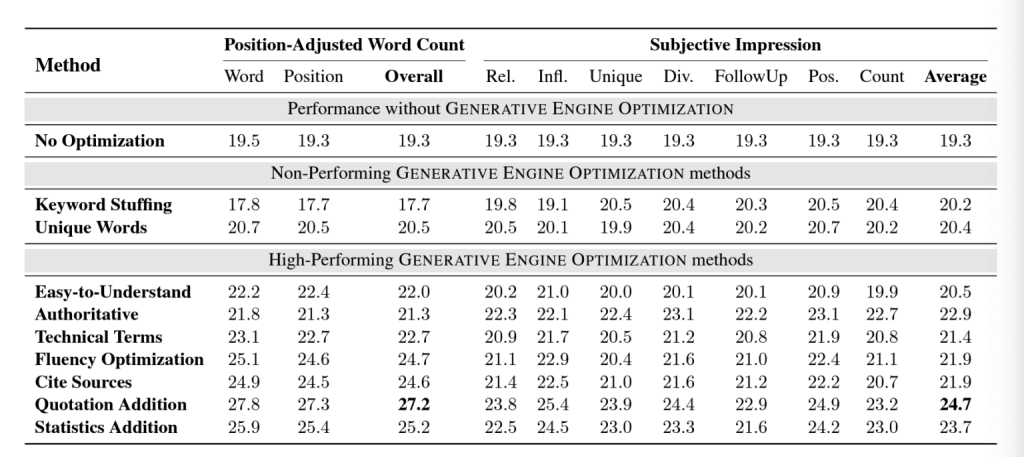
Best Practices:
- Focus on producing long-form content (e.g., blog posts, research papers, guides) and update regularly to ensure accuracy and relevance.
- Add quotable, snackable and relevant data whenever you can.
5. Leverage User Intent and Context
Generative AI engines are excellent at understanding users’ intent. To optimize for GEO, it’s important to ensure your content matches not only the search terms but also the underlying intent of the user.
Best Practices:
- Perform extensive keyword research that goes beyond simple keywords to include user intent and questions.
- Create content that anticipates different types of user needs, such as informational, transactional, or navigational intents.
6. Ensure Technical SEO Is Solid
A technically-optimized website is critical for GEO. AI models need to crawl, index, and process your website effectively. If your website is slow, difficult to navigate, or hard to understand from a technical perspective, generative engines will struggle to rank it well.
Best Practices:
- Optimize page load speeds by compressing images, minifying CSS and JavaScript files, and utilizing browser caching.
- Ensure your website is mobile-friendly, as generative AI engines consider user experience across devices.
7. Optimize for Multimodal Content
As generative engines become more advanced, they can handle multimodal inputs such as images, videos, and audio. Optimizing your content for AI systems means embracing these multimedia formats.
Best Practices:
- Add relevant alt text to images and transcriptions to videos so AI can interpret them correctly.
- Consider creating podcasts or video content that generative AI systems can include in its results.
As GEO becomes more important, it’s likely to also become more complex. For now, making subtle changes to your search strategies is a great way to get ahead of the pack. Tomorrow’s AI-driven future is sure to surprise, so be prepared to continually adapt your tactics as these models grow and mature.
Email us at Hello@ReifyCreative.com if you’d like to know how to optimize your website to please the generative bots!